How to strategically prioritize your long-term projects
There are so many different systems and techniques for prioritizing your tasks and projects, but today's framework has become one of my favorites for looking at long-term projects and goals. This is great for any of you who have busy seasons at work, tend to get distracted with new ideas you want to run with, or get overwhelmed when trying to prioritize all the projects on your plate.
This can be used in the moment when you're feeling overwhelmed, or plan to do this quarterly to help you stay on track with your goals and what's most important throughout the year.
This is kind of a variation on the Eisenhower Prioritization Matrix to look more strategically at longer term projects, so I'm calling it the Strategic Priorities Matrix.
First, start a list of all the ideas, projects, and to do's that you're looking to prioritize. It could be looking at one big project or all of your priorities currently on your plate - whatever makes most sense for where you're at right now.
Next, define what high vs. low impact is for you. I like to think of this as the value or impact it will have on your short or long term goals. Is it something you know will move you closer to achieving your ultimate goal? Then it would be high impact. Is it something that you don't know if it will have an impact yet because it's a new initiative? Then it may still be considered low impact.
Then, we need to define what is high effort vs. low effort. Most common factors to consider here are the amount of time and/or cost to complete the task. This will again vary depending on what type of project or role you're in, so decide for yourself what you want the parameters to be. Is the threshold for something low effort less than an hour of work or less than eight hours of work? Is having four people involved in a project high effort? Do you have to learn a whole new software system before you can implement this step?
Now, go through your list of tasks from above and assign each task to one of the four quadrants based on your own definitions.
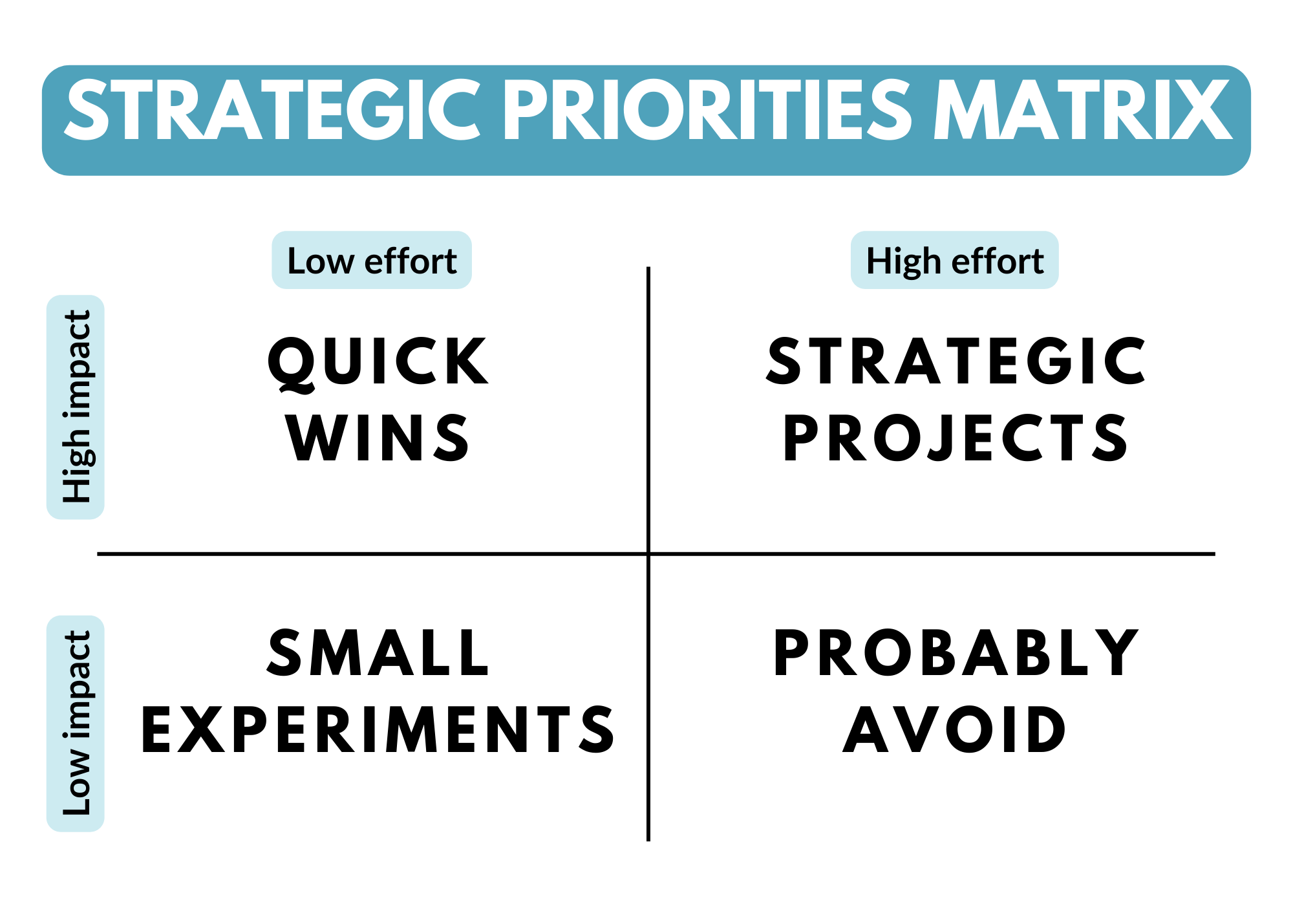
Quick wins: High impact, low effort
These are the tasks you know will move you forward on a goal and shouldn't take too much time, money, or resources to complete.
Examples: Follow up emails to clients/leads, finalizing revisions on an RFP, updating a client-facing email template.
Watch outs: Sometimes these are simple things you've been putting off because it's down to the details or it's your least favorite part of the project. Sometimes these are de-prioritized for the shiny new fads or ideas that are actually riskier.
Recommendation: Prioritize these highest in your calendar (consider daily or weekly).
Strategic projects: High impact, high effort
These are usually long term projects that you can't be completed in one sitting or have more elaborate planning and resources involved.
Examples: Creating a new committee to evaluate the effectiveness of a new software, creating Standard Operating Procedures (SOPs), building a quarterly report to learn key insights across our client accounts.
Watch outs: These easily get de-prioritized for more urgent or quick turnaround projects that feel more satisfying to quickly check off your list. Remember, it may take time to see your efforts pay off here and that's okay.
Recommendation: Schedule time to dedicate to these on your calendar in advance so they don't get forgotten. Remember your why (high impact) if you try to de-prioritize or push back on your commitment.
Small experiments: Low impact, low effort
These tasks are likely back burner projects when you have extra time or someone on your team has time to test new ideas. You may not yet know how effective they are, or they're more 'nice to have' and may indirectly provide value over the long term that's hard to measure or see clearly.
Examples: Submitting your perspective on a thought leadership article, testing out new social media trends, and re-organizing your files or emails.
Watch outs: Just because they are low effort doesn't mean they are urgent or a priority. Don't prioritize these above the high impact tasks. Be real with yourself about their impact.
Recommendation: If you're tempted to keep prioritizing these higher on your list, consider these tasks a reward for completing (or making progress on) strategic projects first.
Probably avoid: Low impact, high effort
This is usually the shiny new fad that isn't proven out yet but you want to try or it's something new to you that could be a high effort simply because there's a big learning curve to implement it.
Examples: Transitioning the whole company's CRM or email software to a new provider, testing out different AI tools, and reorganizing a team or department.
Watch outs: A lot of us are tempted to categorize something as high effort immediately as high impact. Once again, be real with yourself about the impact of these activities so you don't waste too much time here.
Recommendation: If you decide it is worthwhile to approach the task, set a time limit for yourself or the team. What would be a reasonable amount of time for you to experiment with it to know if it's worthwhile without distracting you or pulling away from higher priority projects?
If your long-term projects keep getting bumped by the urgent stuff, a Leader Reset Session can help you get clear on what actually matters. Learn more and book here.

Brittany Canaski is a highly-rated Leadership Coach, Trainer, and Founder of Hello Velocity where she builds confident leaders and high-performing teams. When she's not building her business, you can find her planning her next travel adventure with her husband, watching Formula 1 racing, or volunteering in her local community of Charlotte, NC.