How high-performing leaders track their goals - and their team’s - all year long
Leaders have a lot of goals to stay focused on throughout the year. They're often having to navigate this middle ground of high-level strategic goals of the company, department, and their team, in addition to the individual goals of each person on their team, not to mention their own goals as an individual.
What I see helps high-performing leaders make consistent progress and stand out among other leaders is the systems they have to support them all year long and more importantly, their commitment to these systems.
Your systems will vary based on your organization, team, and even industry. You can have systems to help you manage your emails, your deep focus time, or your team's KPIs. But today we're going to focus on our annual goal tracking systems, specifically.
A lot of times we set our annual goals at the beginning of the year and forget them until our year-end evaluations come around (you're not alone!). By creating some simple systems at the beginning of the year, we will set ourselves up better for steady progress throughout the year, and will save ourselves a ton of time at the end of the year when preparing for year-end performance review evaluations for ourselves and our team members.
There are four steps to creating a goal-tracking system to support you and your team:
Put all your goals in one place that's easy to find
Before we can create a goal-tracking system, we need to get really clear on what we are tracking. When it comes to your own and your team's professional goals, most leaders need to be tracking:
Aggregate goals
Your team's goals
Your department's goals
Company-wide goals
Your team member's goals
Role-specific goals
Professional development goals
Your own goals
Role-specific goals
Professional development goals
A lot of organizations I've worked with set their goals at the beginning of the year and it lives in some sort of online HR software that people only check when they have to for annual or quarterly reviews, or they live in an arbitrary presentation deck that gets shared infrequently in all-hands meetings. I want to challenge you to take the ownership of gathering the information you need and be accountable to checking it regularly (we'll talk about that more in step 3).
I recommend putting these all in one document that you can refer back to easily and regularly. It helps to see them all together all at once to begin to think strategically about how they can support one another. And it's helpful to get in the habit of checking it regularly to help you prioritize for your team and of course, to not forget them throughout the year.
2. Break your goals down into milestones
We need to break your goals down into milestones, or smaller steps along the way to create layers of accountability throughout the year. We don't want it to be a mad dash at the end of the year to try to accomplish these things we forgot about, and we don't want to try to take on new projects when we know it'll be our busy season.
I recommend you do this by looking at your goals above and think about the smaller steps or milestones that need to be accomplished along the way. You can learn some new strategic thinking techniques in my previous blog post: Strategic thinking techniques to help you be more proactive. You don't need to assign dates yet, just brainstorm the steps and put them in chronological order.
You may not need to do this for all the goals (like the company-wide goals specifically), use your best judgment for which goals need milestones.
3. Integrate your goals into reality
Next, we need to be able to integrate these goals into our short-term and long-term schedules and assign deadlines. In other words, how to bring these to life and actually execute on them. Without this, we're planning in a hypothetical 'best case scenario' world which is simply not reality (sorry not sorry).
To do this, we need to look at how these potential milestones can fit into the bigger picture of what else is going on throughout the year. So we can look to the year ahead as a whole to get some loose structure for:
any big projects or deadlines you know of already
your usual busy and slow seasons
any big company-wide events or initiatives
when teammates may be on vacation
anything else date-specific in your industry or company (trade fairs, pitch meetings, conferences, donation seasons, customer events, etc.)
We want to be able to see how our goals, milestones, and events can work together, not compete.
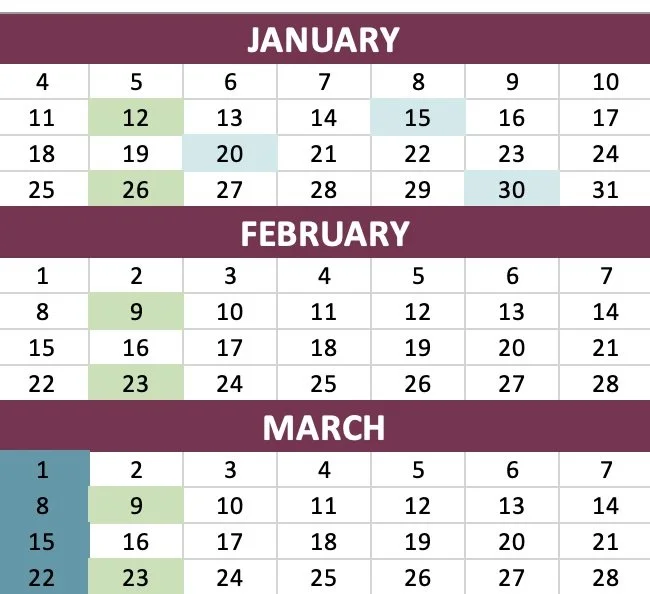
Example of Brittany’s long-term planning view
You may want to use a long-term calendar, planner, or digital view where you can see monthly and/or quarterly view at a time. I create a digital calendar in excel each year for myself to track my client events, vacations, podcast seasons, etc. This helps me not overcommit to things when I know I'll be busy or around a big trip. I'm also a visual person so this really helps me instead of trying to click into my google calendar for weeks at a time.
We do this to remember that not every day, week, or month is going to be the same, and that's okay! We just need to be mindful of it. Some weeks you may have multiple projects at once, bigger deadlines, or events that may take more planning or energy. You also need to consider how your personal plans may impact this as well - travel, birthdays, holidays, back to school schedule changes, and more.
So if in an ideal world, you only need 2 weeks to complete a project, but you look at the calendar and realize you'll be traveling to a customer on-site meeting one of those weeks, you need to add an extra week to your deadline.
It's important to note that planning a year out in advance means these preliminary plans will likely change along the way. New projects will pop up, deadlines will change, and vacations will happen. That's okay, we just need a starting point for now. I recommend you re-visit this each quarter to adjust and get more specific as needed.
4. Schedule regular check-ins with yourself and your team
Now, the system to hold you accountable throughout the year. You need a system that allows you to easily track your progress towards these goals and milestones, learn and adjust as needed, all throughout the year. Some of mine and my client's favorite ways to do this are:
Weekly wins - keep an on-going list each week of your own and your team's wins - big or small. Don't want to celebrate when you've met a big deadline or milestone, celebrate all the little steps along the way too.
Monthly reflections - track what projects you've worked on, for which clients or teams, and what goals you've worked towards or supported
Quarterly development - have a discussion with each team member each quarter about their long-term development goals and progress.
Quarterly milestones adjustments - like I mentioned above, revisit your deadlines and milestones each quarter (at least) and adjust as needed
For each of these, you'll need a way to remember to do these. Create reminders that have worked for you in the past - whether it's scheduling a meeting with yourself, with a peer to hold each other accountable, reminders on your phone, your planner, etc.
We can create systems all day to support these goals, but like I said earlier, the most important part is your commitment to these systems. That looks like being dedicated to doing these daily, weekly, monthly, even when you're super busy or when life throws you a curve ball.
If you want a thought partner to help you build (and stick to) your own tracking system this year, book a free discovery call.

Brittany Canaski is a highly-rated Leadership Coach, Trainer, and Founder of Hello Velocity where she builds confident leaders and high-performing teams. When she's not building her business, you can find her planning her next travel adventure with her husband, watching Formula 1 racing, or volunteering in her local community of Charlotte, NC.