How to prioritize when everything feels urgent
You keep waiting for things to slow down to be able to think clearly again but they're not.
Maybe your team is short-staffed, you're working on some big deliverables, or there seems to be urgent last-minute requests each day or week. You're probably struggling to manage your time and schedule.
When you're busy and overwhelmed, it can be hard to see your priorities clearly in the moment.
You may start just powering through any easy work just to feel like you're getting something done.
You may switch between tasks constantly because you're not really sure where you should be focused.
You may keep switching to whatever task someone most recently asked you to work on because it feels most urgent.
Or you may even shut down a bit and avoid everything by scrolling on social media as a distraction.
Whatever busy season you're in, I've got you.
What you need is a quick tool you can use each week, day, or hour when you're feeling overwhelmed in order to help you prioritize and know what to focus on next.
My favorite way to do this is with the Eisenhower Prioritization Matrix.
This tool is named after President Dwight D. Eisenhower who was first attributed with this decision-making technique.
In order to understand how to use the tool, we need to first understand the difference between urgent and important.
Urgent means something has an approaching deadline.
Important means something has significance to your goals or projects.
The key here that Eisenhower is said to have emphasized, is that what's urgent is often not important. And what's important is often not urgent. So it's very important to identify the differences in the moment.
But when you're being asked for last-minute requests from clients, bosses, and teammates - we often aren't thinking through this lens. It can feel like everything is urgent and important.
So the best way to help you navigate those moments of not knowing what to focus on next, use this matrix as a tool to help you categorize your to do list, tasks, or projects.
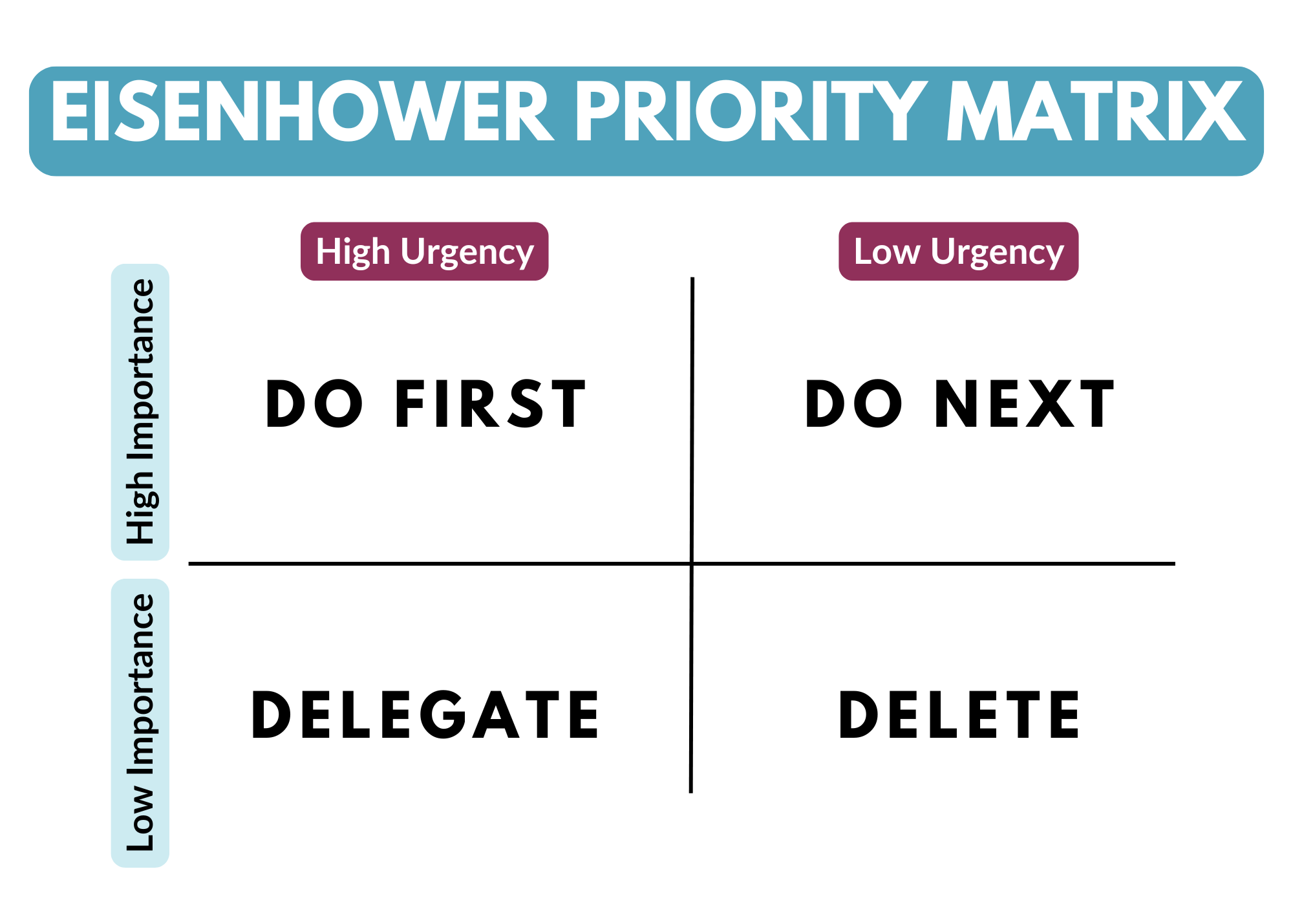
1.High Importance + High Urgency: Do First
This quadrant includes time-sensitive projects and client-facing deadlines. The majority of our time needs to be spent here to keep us moving forward towards our goals. Remember to stay clear on your goals as a team and organization so you know what is important.
Examples include: Preparing for a client presentation, emailing an agenda for tomorrow's Board meeting, supporting your overwhelmed team navigate a disagreement, approving budget requests, and responding to an issue with a client's order.
Problems to watch out for here: Other people's requests may seem important, or are important to them, but are they important to you, your team, or role? It's okay to push back on requests that come your way as needed. Sometimes people ask for something 'ASAP' but don't actually need it immediately, or it's only urgent because of their lack of planning which needs a bigger conversation.
2.High Importance + Low Urgency: Do Next
This quadrant includes projects and tasks that will support long-term growth, but usually don't have a hard deadline. Most people need to spend more time here but without the external deadline, it can be hard to commit to it.
Examples include: Researching a new tool that may save you time, building succession plans, measuring your progress against your annual goals, and building relationships in your industry.
Problems to watch out for here: This category is the easiest for us to de-prioritize because there isn't an immediate deadline and we don't see the benefit of it in the short-term. These tasks are all about playing the long-game by investing time consistently now to see benefits in the long-term.
3.Low Importance + High Urgency: Delegate
This quadrant includes the things that are inconsequential or distract us in the moment. We need to limit the amount of time we spend on these tasks.
Examples include: Answering emails someone else on your team could handle, researching or gathering information someone else could do, and last minute requests that don't require your expertise.
Problems to watch out for here: This is often were we confuse urgency for importance. When there's an approaching deadline or urgent request from someone else, and you feel like you have time to work on it, it's easy to just jump in without thinking about it. Start questioning these by asking if they require your expertise or if someone else could do it just as well.
4.Low Importance + Low Urgency: Delete
This quadrant tends to be where we waste time and energy. We need to eliminate our time here as much as possible.
Examples include: Attending meetings where you're not needed or the meeting could have been an email, constantly checking every email or Slack notification as it pops up, over-editing a presentation to strive for perfection, creating processes that don't save time or efforts, and scrolling social media.
Problems to watch out for here: For a lot of people, these are the tasks that keep you busy and in turn, make you feel important or valued. They may be automatic habits for you that can take some time to walk away from. You may need a bigger mindset shift in order to be able to remove these from your habits altogether.
At first it may feel hard to use this tool in the moment but over time it becomes easier to tell where tasks, notifications, and requests fall into this.
An easy place to start is to print out the visual and hang it by your work desk. You can use it as a quick gut check in the moment.
Or take your current to do list and assign each item to one of the four quadrants.
Prioritization is just one lever. If you're constantly firefighting, there may be a bigger pattern at play. Take the free Leadership Blind Spot Audit to see which habits are quietly working against you. Take the audit here.

Brittany Canaski is a highly-rated Leadership Coach, Trainer, and Founder of Hello Velocity where she builds confident leaders and high-performing teams. When she's not building her business, you can find her planning her next travel adventure with her husband, watching Formula 1 racing, or volunteering in her local community of Charlotte, NC.